
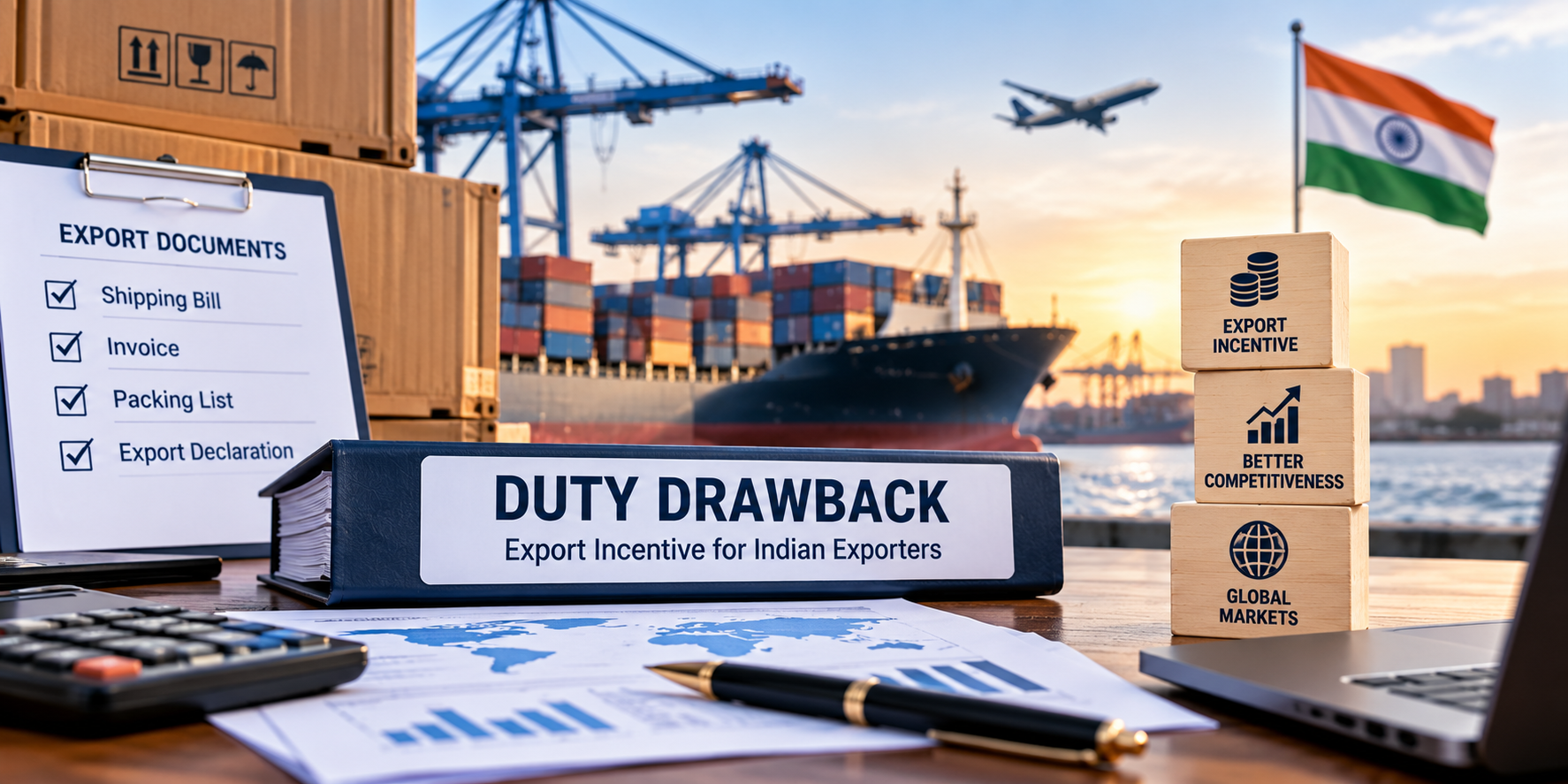
Duty Drawback on Exports can help eligible exporters recover certain customs duties under applicable rules. For businesses handling regular shipments, a claim that is delayed or lower than expected can affect cash flow and create extra follow-up work.
The amount and process depend on the exported goods, the applicable rate and the conditions for the claim. Here is a practical overview of how Duty Drawback on Exports works and what exporters can check.
What Is Duty Drawback on Exports?
Duty drawback is a rebate of specified duties in eligible circumstances. Under Section 75 of the Customs Act, drawback may be allowed on eligible imported materials used to manufacture, process or carry out an operation on goods that are exported. Section 74 covers a different case: eligible goods imported into India with duty paid and later re-exported. See the CBIC provisions on Section 75 and Section 74.
Duty drawback is not an automatic refund of every tax or cost connected with an export. The exporter needs to check the applicable rules, rates and conditions for the product and transaction.
How Are Duty Drawback Rates Determined?
Two commonly referenced routes are the All Industry Rate (AIR) and the Brand Rate.
The All Industry Rate is notified for specified goods in the applicable drawback schedule. A Brand Rate may be relevant when the notified rate does not adequately reflect the eligible duties for a particular product, subject to the prescribed application and supporting information. The DGFT export guidance describes both routes.
Rates and conditions can vary by product classification. Before estimating a Duty Drawback on Exports claim, check the relevant tariff item, current schedule entry and any conditions or value limits that apply. Do not assume the rate for one product or shipment applies to another.
How Is a Duty Drawback Claim Made?
For many export transactions, the drawback details are included in the Shipping Bill. The exporter or authorised customs broker should ensure that the relevant information is entered correctly and matches the supporting export documents.
After export, the claim moves through the applicable Customs processing steps. If the Shipping Bill information is incomplete or inconsistent, the claim may need further review. Keep the Shipping Bill number and date, product classification, invoice and export records available when checking a claim.
How to Check a Duty Drawback on Exports Claim
ICEGATE provides an enquiry to check whether a drawback claim is pending or sanctioned. The enquiry instructions ask users to enter details such as IEC, PAN, location and the relevant date range, then select the pending or sanctioned status option.
For a pending claim, the enquiry can show the current processing queue. For a sanctioned claim, it can show details such as the scroll number, date and amount. The ICEGATE drawback enquiry guidance explains how exporters can check this status.
This status check helps distinguish a claim that is still being processed from one that has been sanctioned. If a drawback amount does not appear under pending status, check the sanctioned status as well.
Why Might the Amount Differ From Your Estimate?
A difference between an internal estimate and the sanctioned amount does not automatically mean there is an error. The applicable rate, product classification, quantity, value limit and scheme conditions can affect the amount.
Review the relevant schedule entry alongside the Shipping Bill and product details. If you handle multiple shipments, compare the records across them to see whether the same issue appears repeatedly.
Keep Shipment-Wise Records
A simple shipment-wise tracker can make a Duty Drawback on Exports review easier. Record the Shipping Bill number and date, product classification, declared drawback details, EGM status, enquiry result and any scroll information. Reviewing these details periodically can help identify older claims that need follow-up and recurring discrepancies across shipments.
For a broader checklist of export paperwork, see our guide to documents required for export from India.
Need Help Reviewing Duty Drawback Claims?
If your business has pending claims, differences in expected amounts or several Shipping Bills to review, a transaction-wise check can help identify which records may need attention. Exim Compliance Partner assists exporters with Duty Drawback on Exports, RoDTEP, IGST refunds and related EXIM compliance matters.
Contact us to discuss support for your export transactions.
Exim Compliance Partner
Smart Compliance.. Secure Trade..