
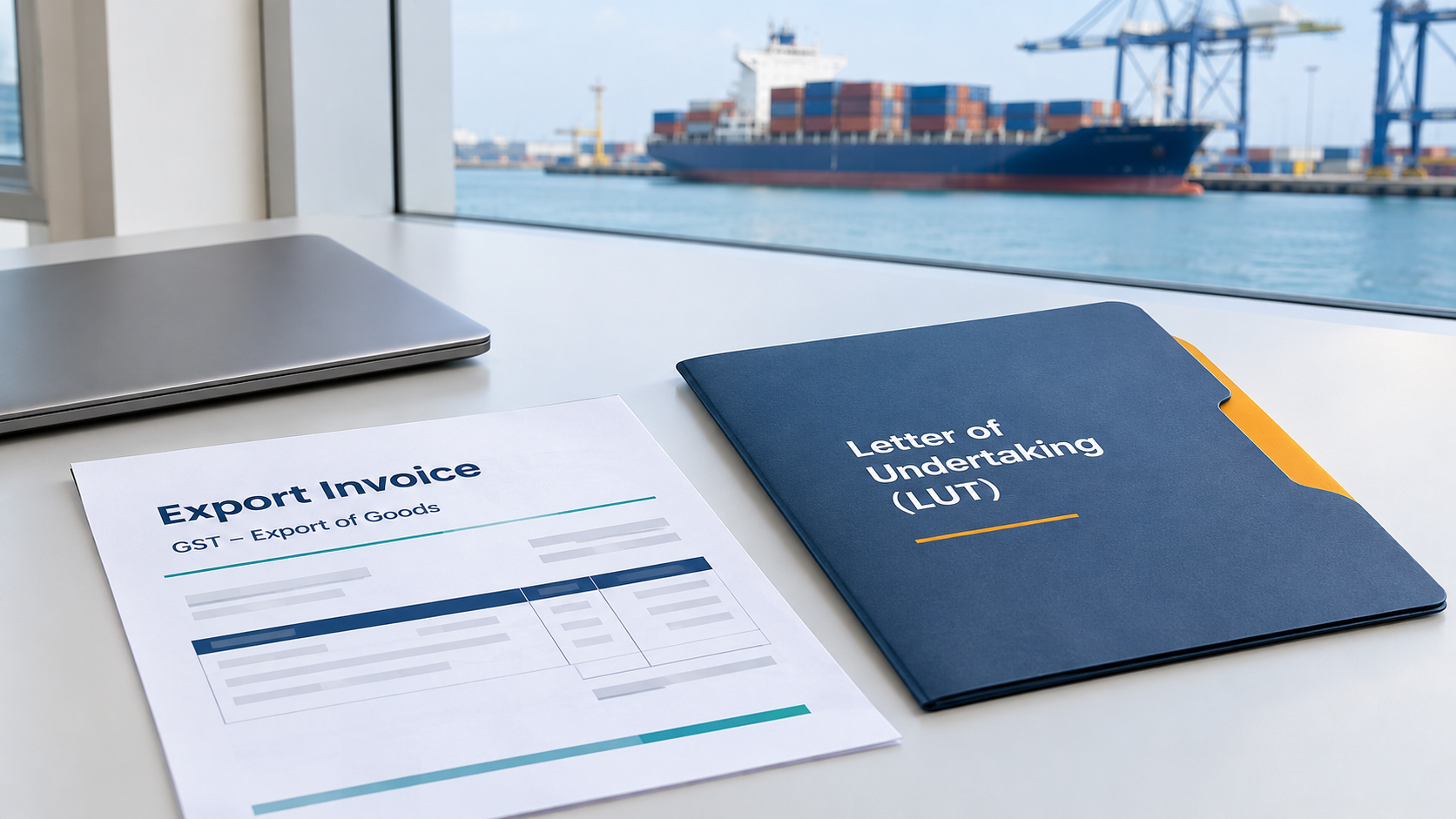
Export Under LUT allows eligible registered exporters to supply goods or services for export without paying Integrated GST at the time of export, subject to applicable GST rules. LUT stands for Letter of Undertaking. Before using this route, exporters should check their GST records, export documents and LUT filing status.
This route is different from exporting on payment of IGST and then claiming a refund of the tax paid. Under the LUT route, an eligible exporter may claim a refund of unutilised input tax credit, subject to the prescribed conditions. taxinformation.cbic.gov.in
What Does Export Under LUT Mean?
Exports are treated as zero-rated supplies under the GST framework. An eligible exporter may use a bond or Letter of Undertaking to export without payment of integrated tax, following the relevant conditions and procedures.
The LUT is furnished in FORM GST RFD-11. The GST Portal provides an online process for filing it and asks the taxpayer to select the financial year for which the LUT is being applied. tutorial.gst.gov.in
For an Export Under LUT transaction, exporters should ensure the LUT filing is completed before relying on this route and retain the acknowledgement for their records.
7 Essential Checks Before Exporting Under LUT
1. Check Your GST Registration Details
Confirm that the GST registration details used for export documentation are current and consistent across the invoice, GST returns and other relevant records. If your business details have changed, review the registration particulars before preparing export documents.
2. File the LUT for the Applicable Financial Year
Check that the LUT has been furnished for the relevant financial year through the GST Portal. Do not assume that a previous year’s LUT covers exports for the current year. Save the acknowledgement and Application Reference Number generated after submission.
3. Complete the Filing Before the Export
Rule 96A states that a registered person using the LUT route must furnish a bond or LUT in FORM GST RFD-11 before export. Keep the accepted filing details available to the people preparing invoices and shipping documents. IndiaCode
4. Keep the Invoice and Shipping Bill Information Consistent
Compare the export invoice and Shipping Bill details before filing. Check the exporter’s GST details, invoice number and date, export value, description of goods and other shipment references. Consistent information makes it easier to reconcile GST records with Customs documents.
5. Apply the Correct GST Treatment
Ensure the transaction is documented as an export without payment of integrated tax under LUT, where that is the route selected and permitted for the transaction. Exporters should not mix up this treatment with the route for exports on payment of IGST.
The two routes involve different refund considerations: the LUT route may involve a refund of eligible unutilised input tax credit; the payment route concerns a refund of IGST paid, subject to applicable provisions. For more detail, see our guide to IGST refund on export of goods. taxinformation.cbic.gov.in
6. Track the Applicable Export and Payment Timeframes
The rules include timeframes relating to export of goods and receipt of payment for export services. Requirements and possible extensions can differ by transaction type and circumstances. Review the applicable rule and obtain advice if a shipment or service payment may fall outside the relevant timeframe.
7. Reconcile Returns and Input Tax Credit Records
Review the export information reported in GST returns and compare it with invoices and shipping records. If claiming a refund of unutilised input tax credit under the LUT route, confirm that the refund application and supporting records follow the applicable process.
Common Errors Exporters Should Avoid
Issues can arise when the LUT is not filed for the relevant financial year, documents use inconsistent invoice details, or the business applies the wrong GST treatment to the export. Incomplete reconciliation between GST returns, export documents and refund records can also make it harder to identify where a discrepancy occurred.
A simple shipment-wise tracker can help. Record the invoice number, Shipping Bill number where relevant, export date, LUT acknowledgement, export value, return period and refund status. Regular review can make Export Under LUT compliance easier to monitor across multiple shipments.
For a broader export document checklist, see our guide to documents required for export from India.
Need Help Reviewing Your Export Records?
If your business has questions about LUT filings, export documentation or an input tax credit refund, a transaction-wise review can help identify records that may need attention.
Exim Compliance Partner assists exporters with GST export documentation, IGST refunds, eBRC and related EXIM compliance matters.
Exim Compliance Partner
Smart Compliance.. Secure Trade..
Reserve Bank of India
Export Realization, Bank and RBI coordination Support
EDPMS , IDPMS Closure ( RBI Compliance )
What are the documents required for Export
How to Close EDPMS Entries in India
DGFT Licensing – EPCG & Advance Authorization
IRM Settlement & Purpose Code Correction
eBRC for Exporters: 7 Essential Steps to Avoid Delays