
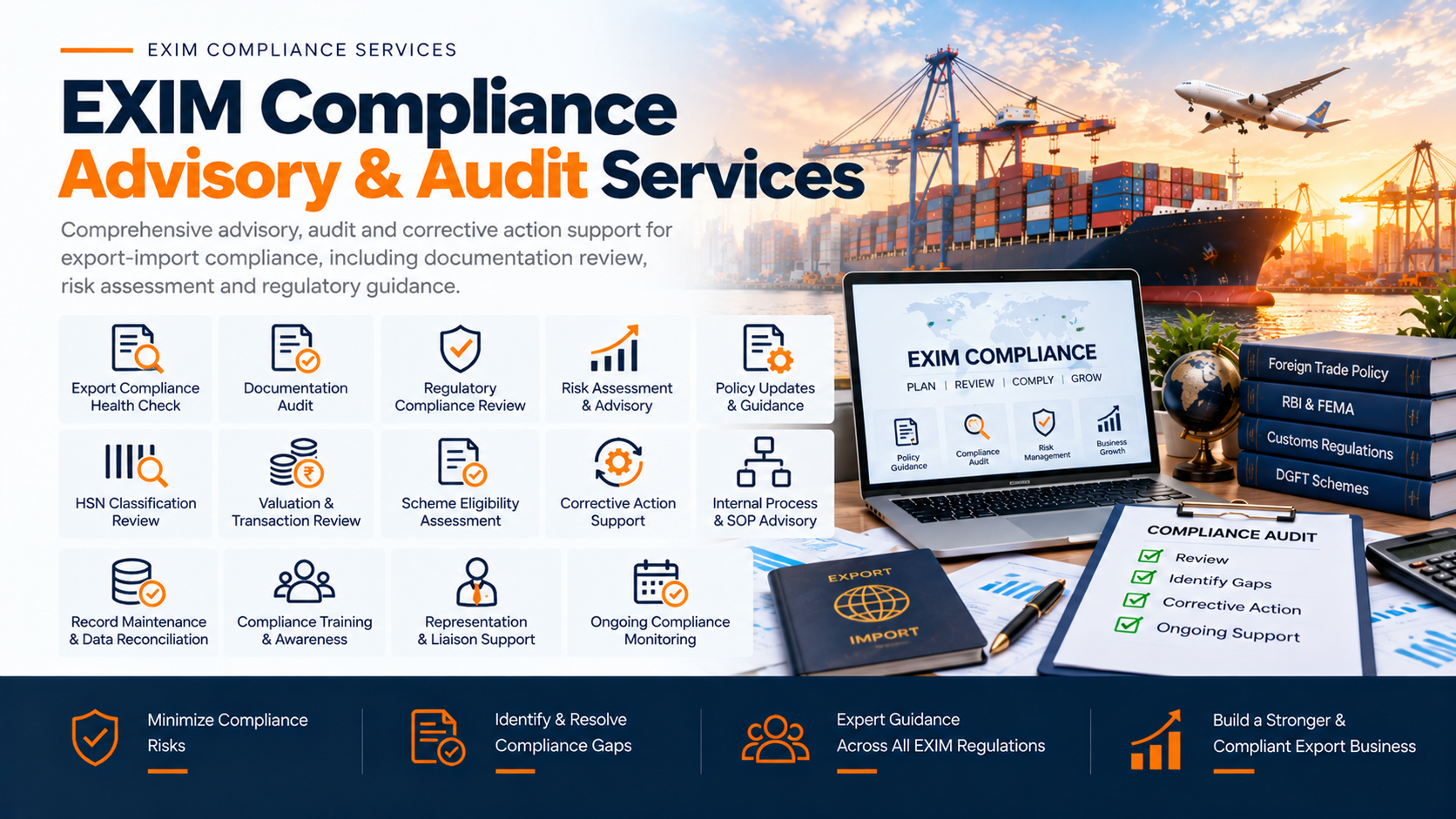
Expert EXIM Compliance Audit Services for Exporters and Importers in India
Managing export-import operations requires accurate documentation, regulatory reporting, banking reconciliation and compliance with applicable Indian trade laws. Unresolved EDPMS entries, incorrect eBRC details, pending shipping bills and discrepancies in export incentive claims can create significant operational and regulatory challenges.
At EXIM Compliance Partner, we provide professional EXIM Compliance Audit Services to help Indian exporters, importers and manufacturers identify compliance gaps, review historical transactions and implement appropriate corrective measures.
With 18+ years of export-import industry experience, our consultancy offers specialized advisory and compliance review services covering RBI, FEMA, DGFT, Customs, export realization, banking records and export incentive schemes.
Our approach focuses on identifying unresolved transactions, assessing documentation accuracy and helping businesses establish stronger compliance management practices.
Our 13 Essential EXIM Compliance Audit Services
1. Three-Year & Five-Year EXIM Compliance Audit
A periodic review of historical export-import transactions helps businesses identify unresolved compliance issues that may have accumulated over several financial years.
Our EXIM Compliance Audit Services include structured reviews covering three-year or five-year periods, depending on the client’s transaction history and requirements.
Our review includes:
- Examination of historical export-import records.
- Identification of pending shipping bills and banking entries.
- Review of export realization and remittance documentation.
- Assessment of relevant DGFT authorisations and obligations.
- Identification of documentation and reporting discrepancies.
- Preparation of a compliance observation summary.
A historical review can help businesses identify issues before they lead to additional regulatory queries.
2. EDPMS Audit
The Export Data Processing and Monitoring System (EDPMS) enables authorised banks to monitor export transactions and associated realization records.
Outstanding EDPMS entries may result from mismatched payment information, incomplete reconciliation or unresolved export documentation.
Our EDPMS audit assistance includes:
- Reviewing outstanding shipping bill records.
- Identifying pending export realization entries.
- Matching invoices with inward remittances.
- Examining discrepancies in available banking data.
- Preparing reconciliation statements.
- Identifying cases requiring AD bank coordination.
Our objective is to help exporters understand the reasons for outstanding transactions and pursue appropriate corrective action.
3. IDPMS Audit
The Import Data Processing and Monitoring System (IDPMS) supports monitoring of import transactions and related banking information.
Differences between import payments, bills of entry and bank records can create unresolved reporting entries.
Our IDPMS review includes:
- Reviewing pending import transactions.
- Matching outward remittances with import documentation.
- Identifying missing or inconsistent bills of entry.
- Reviewing documentation supporting import payments.
- Preparing transaction-wise discrepancy reports.
- Recommending eligible reconciliation and correction steps.
Our EXIM Compliance Audit Services help importers identify outstanding documentation and banking compliance matters.
4. eBRC Audit
Electronic Bank Realisation Certificates (eBRCs) record export realization information and support certain export-related compliance and incentive processes.
Incorrect realization details can create difficulties during documentation reviews and benefit claims.
Our eBRC audit covers:
- Verification of available eBRC records.
- Matching export invoices with realized payments.
- Reviewing shipping bill and remittance information.
- Identifying missing or incorrect realization entries.
- Examining relevant supporting documents.
- Recommending appropriate correction procedures.
We help exporters maintain consistent records across applicable DGFT and banking systems.
5. Shipping Bill Audit
Shipping bills contain important export declaration information used for Customs clearance, reporting and applicable export incentive processes.
Incorrect classifications, invoice details or shipping information can affect subsequent transaction reconciliation.
Our shipping bill audit includes:
- Verification of exporter and shipment information.
- Reviewing product descriptions and HSN classifications.
- Comparing shipping bills against commercial invoices.
- Identifying incomplete or incorrect declarations.
- Reviewing relevant incentive-related information.
- Highlighting eligible amendment requirements.
Our EXIM Compliance Audit Services help exporters identify inconsistencies across shipping bills and associated export documents.
6. Export Realisation Audit
Exporters must monitor the realization and repatriation of export proceeds according to applicable RBI regulations.
Unresolved receivables and incomplete payment records may create compliance difficulties.
Our export realization review covers:
- Reviewing outstanding export invoices.
- Reconciling realized payments with shipping bills.
- Identifying overdue export proceeds.
- Examining short-payment and adjustment records.
- Reviewing available bank confirmations.
- Identifying transactions requiring follow-up.
We help businesses improve visibility over outstanding export receivables and related regulatory requirements.
7. DGFT Incentive Audit
Government export promotion schemes and benefits are governed by applicable eligibility, documentation and compliance conditions.
A review of incentive records can help identify pending claims, incorrect declarations and potential compliance gaps.
Our DGFT incentive audit includes:
- Reviewing relevant export incentive transactions.
- Examining authorisations and applicable scheme conditions.
- Identifying unclaimed or incorrectly recorded eligible benefits.
- Verifying supporting shipping bill information.
- Reviewing outstanding incentive discrepancies.
- Recommending appropriate follow-up actions.
Through our EXIM Compliance Audit Services, exporters can improve documentation and oversight of eligible incentive claims.
8. IGST Refund Review
Eligible exporters may claim refunds of Integrated Goods and Services Tax paid on qualifying exports, subject to applicable GST and Customs procedures.
Discrepancies between GST returns, shipping bills and export invoices may delay processing.
Our IGST refund review includes:
- Reviewing pending refund transactions.
- Comparing relevant GST return information.
- Identifying invoice and shipping bill mismatches.
- Examining available refund status information.
- Reviewing supporting export documents.
- Recommending eligible corrective procedures.
We assist exporters in identifying documentation issues affecting their refund processes.
9. Duty Drawback & RoDTEP Review
Duty Drawback and the Remission of Duties and Taxes on Exported Products (RoDTEP) Scheme provide specified benefits to eligible exporters under applicable conditions.
Incorrect declarations, product classifications or reconciliation errors can affect claims.
Our review covers:
- Reviewing applicable benefit eligibility.
- Checking relevant shipping bill declarations.
- Examining product classification information.
- Comparing available claim and benefit records.
- Identifying pending or inconsistent entries.
- Recommending permissible corrections.
Our EXIM Compliance Audit Services help businesses review export benefit records without assuming that every transaction qualifies for a particular scheme.
10. RBI / FEMA Compliance Review
Foreign exchange transactions are subject to applicable FEMA regulations and RBI directions.
Exporters and importers must maintain appropriate documentation and satisfy applicable reporting and payment requirements.
Our RBI/FEMA review includes:
- Reviewing export-import foreign exchange transactions.
- Identifying relevant reporting discrepancies.
- Examining overdue realization records.
- Assessing supporting remittance documentation.
- Reviewing pending compliance observations.
- Identifying matters requiring professional or bank-level attention.
We help businesses understand the compliance implications of unresolved transaction records.
11. Bank Reconciliation Review
Accurate banking reconciliation is necessary for identifying discrepancies between foreign exchange receipts, outward payments and corresponding export-import documentation.
Our bank reconciliation review includes:
- Matching invoices with inward or outward remittances.
- Reviewing available bank transaction references.
- Identifying missing payment information.
- Examining incorrectly linked transaction records.
- Preparing reconciliation summaries.
- Highlighting cases requiring AD bank coordination.
Our EXIM Compliance Audit Services support improved visibility and accuracy across banking and trade documentation records.
12. Compliance Gap Identification
Compliance gaps may arise when documentation is incomplete, regulatory information is inconsistent or transactions remain unresolved.
Identifying these issues helps businesses prioritize corrective actions.
Our compliance gap assessment covers:
- Reviewing existing documentation processes.
- Identifying missing records and reporting discrepancies.
- Examining unresolved transaction histories.
- Assessing relevant regulatory requirements.
- Classifying observations by urgency and potential impact.
- Preparing a structured compliance gap report.
This review provides businesses with a clearer understanding of areas requiring attention.
13. Corrective Action Plan
Identifying compliance problems is only the first step. Businesses also require a practical process for resolving discrepancies and strengthening future compliance practices.
Our corrective action support includes:
- Preparing a prioritized list of compliance observations.
- Recommending transaction-specific corrective steps.
- Identifying necessary supporting documentation.
- Assisting with relevant banking or authority follow-up.
- Reviewing progress against outstanding issues.
- Recommending improvements in documentation controls.
Our EXIM Compliance Audit Services aim to convert identified compliance gaps into an organized action plan.
Why Choose EXIM Compliance Partner?
Export-import compliance involves multiple regulatory frameworks, documentation systems and financial transactions.
At EXIM Compliance Partner, we offer:
- 18+ years of export-import industry experience.
- Comprehensive review of banking, DGFT, Customs and incentive records.
- Assistance with complicated historical pending transactions.
- Structured documentation and reconciliation support.
- Identification of potential compliance gaps.
- Practical corrective action recommendations.
- Personalized advisory support for exporters and importers.
Our EXIM Compliance Audit Services focus on helping businesses identify risks, strengthen documentation practices and take informed corrective steps.
Our EXIM Compliance Audit Process
Step 1: Initial Consultation
We discuss the business’s export-import activities, transaction volume, existing documentation and areas of concern.
Step 2: Document Collection & Review
Our team examines relevant shipping bills, invoices, banking records, eBRC information, authorisations and incentive documents.
Step 3: Compliance Gap Assessment
We identify outstanding transactions, documentation discrepancies and potential areas of regulatory non-compliance.
Step 4: Audit Observation Report
We prepare a structured summary of findings, outstanding issues and recommended corrective actions.
Step 5: Corrective Action Assistance
Where agreed, we help businesses prepare supporting documents and coordinate appropriate follow-up procedures.
Step 6: Periodic Compliance Monitoring
Businesses may choose periodic reviews or ongoing advisory assistance to monitor unresolved matters and improve compliance practices.
Ongoing EXIM Compliance Advisory & Retainership
Export-import compliance requires continuous attention as regulations, documentation requirements and business transactions change.
For businesses with regular international trade activities, EXIM Compliance Partner can provide ongoing advisory and monitoring support.
Retainership services may include:
- Monthly or quarterly compliance reviews.
- Monitoring outstanding export realization records.
- Reviewing pending banking and Customs discrepancies.
- Periodic export incentive reconciliation.
- Assistance with documentation-related queries.
- Tracking previously identified compliance gaps.
- Guidance on relevant regulatory updates.
A structured retainership can help businesses maintain better compliance oversight throughout the year.
Frequently Asked Questions
What are EXIM Compliance Audit Services?
EXIM Compliance Audit Services involve reviewing export-import transactions, banking records, Customs documentation, DGFT authorisations and applicable compliance requirements to identify discrepancies and recommend corrective measures.
Why should exporters conduct an EXIM compliance audit?
A periodic review helps identify pending transactions, missing documentation, incorrect records and potential regulatory compliance gaps.
Can historical export-import transactions be reviewed?
Yes. Businesses can undertake a three-year, five-year or other agreed-period review depending on the availability of transaction records and the applicable compliance requirements.
Does an EXIM compliance audit guarantee closure of outstanding cases?
No. A compliance review identifies issues and recommends appropriate actions. Closure, corrections, extensions and other outcomes remain subject to applicable rules and decisions by authorised banks or competent authorities.
Is this the same as a statutory audit?
No. This service is a consultancy-led compliance and documentation review. It does not replace a statutory audit, certification, legal opinion or other professional engagement that must be performed by an appropriately qualified or authorised professional.
Related Export-Import Compliance Services
Our EXIM Compliance Audit Services complement other specialized consultancy solutions.
Explore our RBI / FEMA & Banking Compliance Services for EDPMS, IDPMS, eBRC, IRM and export realization assistance.
Review our Export Incentives & Refund Services for IGST refunds, Duty Drawback, RoDTEP and incentive reconciliation.
Learn more about DGFT & Export Authorisation Services covering IEC, EPCG, Advance Authorisation and export obligation compliance.
Explore Customs & Export Documentation Services for shipping bill reviews, amendments and document reconciliation.
You can also browse our complete services or contact our team for assistance.
Official Regulatory Resources
For current government rules, notifications and compliance requirements, consult:
- Reserve Bank of India (RBI) – FEMA directions, foreign exchange regulations and export realization requirements.
- Directorate General of Foreign Trade (DGFT) – Foreign Trade Policy, authorisations and export promotion schemes.
- Indian Customs Electronic Gateway (ICEGATE) – Customs electronic services and shipping bill information.
- Central Board of Indirect Taxes and Customs (CBIC) – Customs and indirect tax regulations.
- GST Portal – GST registration, returns and applicable refund-related services.
Get Expert EXIM Compliance Audit Services in India
Whether your business is facing unresolved EDPMS entries, pending shipping bills, export realization discrepancies, incentive reconciliation issues or historical compliance concerns, EXIM Compliance Partner can help assess the situation.
Our professional EXIM Compliance Audit Services support Indian exporters and importers with structured compliance reviews, documentation assessment and practical corrective action guidance.
Contact EXIM Compliance Partner today to schedule an initial discussion about your compliance review requirements.
Disclaimer: These services involve consultancy-led documentation review, compliance assessment and advisory assistance. They do not constitute a statutory audit or guaranteed regulatory certification. Any formal audit, representation or professional opinion requiring statutory qualifications must be undertaken by an appropriately authorised professional. Regulatory decisions remain with the relevant authorities.
